


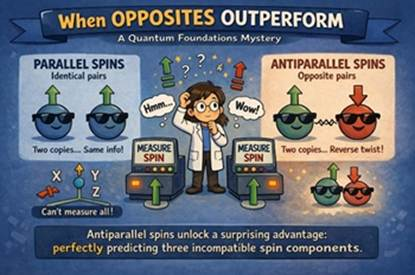
The research demonstrates that quantum particles arranged in antiparallel configurations — where spins point in opposite directions — can encode and reveal more measurable information than parallel quantum states under specific conditions. This breakthrough could improve the efficiency of quantum sensing, secure communications, and next-generation computing systems.
Quantum measurements are fundamentally limited by uncertainty and noise. However, researchers found that antiparallel arrangements enhance distinguishability between quantum states, allowing observers to estimate unknown quantum properties with greater accuracy. The findings deepen scientific understanding of how quantum information can be optimally encoded and retrieved.
The study also highlights potential applications in quantum metrology, where extremely small variations in magnetic fields, time, gravity, or temperature need to be measured with exceptional precision. Enhanced measurement strategies based on antiparallel states may lead to more sensitive sensors and improved navigation, medical imaging, and space technologies.
Researchers noted that the work strengthens foundational knowledge in quantum mechanics while offering practical pathways for developing robust quantum devices. The discovery could further support advances in quantum communication protocols and error-resistant information processing.
The findings represent another important step toward harnessing the unique behavior of quantum systems for real-world technological applications.
